
Embodied Processing
What Is Embodied Processing?
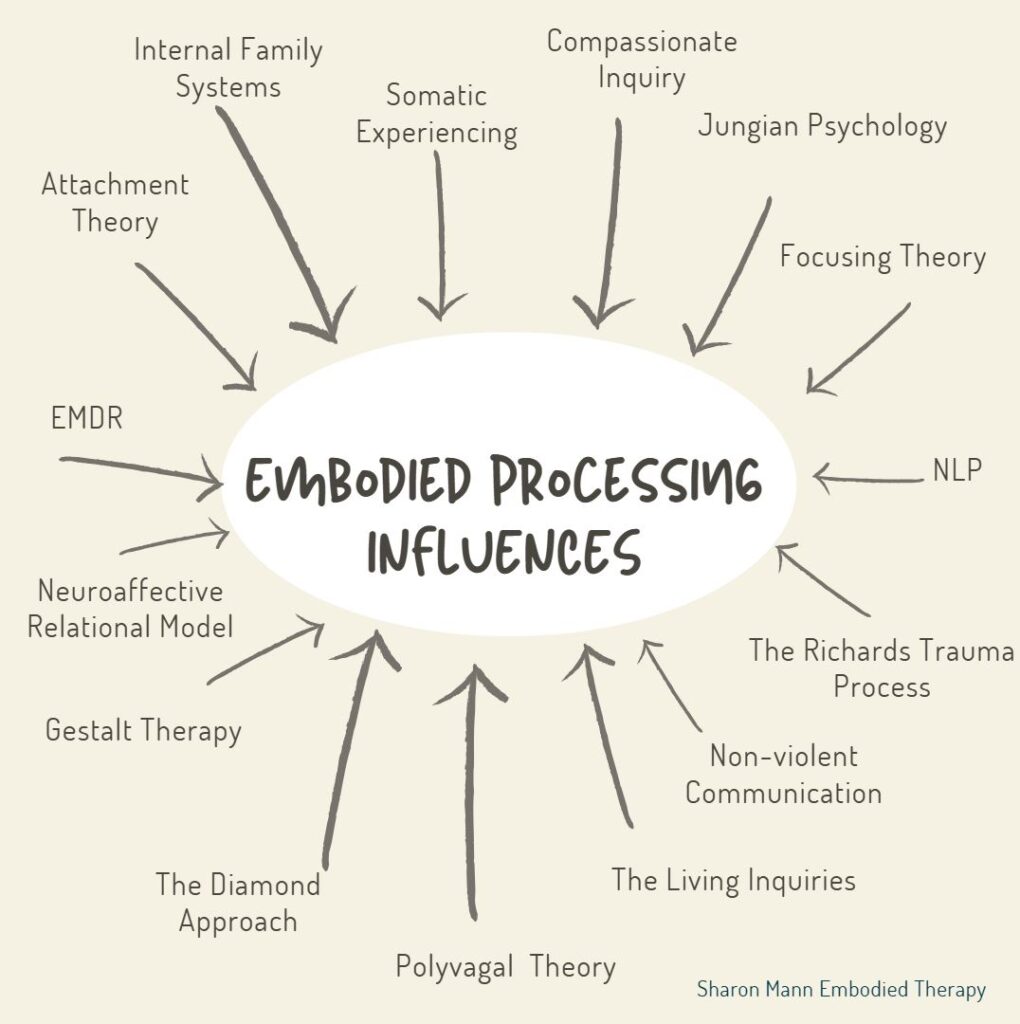
Embodied Processing is a process or framework that is influenced by many different modalities.
EP helps us to explore the roots of our depression, anxiety, trauma, chronic pain, habits, patterns, relationship issues, overwhelm, addiction, and more.
Using curiosity and non-judgment, we follow the body and trust that it has an innate intelligence to bring us back into balance. Positive shifts, insights, softening of protective parts of the body, and transformation happen as we support the process in a safe and regulated way.
Why Choose Embodied Processing?
As we work with regulation and embodiment practices such as TRE, we may find that subconscious material starts to rise to the surface of our awareness. This can show up as memories, impulses, imagery, symbolism, dreams, symptoms, triggers, etc. Embodied Processing (EP) gives us a wonderful way to observe this subconcious content, understand it, sit with it, and process it in a more direct way so it is not stuck in our body and draining or holding our energy back.
Some clients may choose to learn TRE and regulation tools over the course of several sessions and then continue that work on their own, with some refresher sessions here and there. However, the nature of EP tends to lend with working with the EP practitioner over a longer period of time. As this relationship between client and practitioner is built, there can be a greater container to practice working on trust, connection, attunement, and relational pieces. This means that EP can be helpful for developmental and C-PTSD as well as for shock trauma.
What is Parts Work?
Parts work is based off of the model called Internal Family Systems by psychologist Richard Schwartz.
You can find a bit more about it here in my article
or
- at the Resources Page at the bottom at Videos>IFS
Have you ever said, “Part of me wants to do this, but part of me doesn’t?
- “Part of me is excited about the event, but part of me is also really anxious.”
- “Part of me wants to go to the party, but part of me is exhausted and wants to just stay home.”
- “Part of me wants to laugh at what just happened, but part of me knows that just isn’t appropriate here.”
- “I want to rest, but part of me just makes me keep overachieving and overthinking.”
There are countless examples parts may show up in our life. Often times these “parts” are formed at the time of a stressor or traumatic event in our life, as a way for our mind-body system to survive and get through it. Part of our life-force energy splits off and creates a part. It is also very common for there to be many different split-off or orphaned parts and even complex systems of parts that affect each other. In EP, we can start to bring awareness to these parts.
- What is their story?
- What is their job
- When did they start protecting us?
- What burden or pain are they holding?
- What do they need to feel witnessed and cared for?
- How can we help them?
What Does an EP Session Look Like and what is included ?
To simplify greatly:
- We first spend some time in regulating the nervous system and anchoring this relaxation into the body using a variety of resource options.
- Then, if the client is ready for this stage, we invite in the trigger and explore the thoughts, emotions, sensations, impulses, images, and memories connected to the trigger.
- We process this content connected to the trigger with a variety of techniques.
- Throughout the session and also in closing the session, we bring attention to any sense of positive shifts, resolution, and completion.
- We check in with the nervous system and perhaps make a plan for the next session.
- Education is provided throughout as needed
EP versus Other Modalities
It is difficult to put into words the differences I’ve experienced between somatic modalities. I could make some generalities that are often true below.
Tools such as neurogenic tremoring (TRE), vagal toning techniques, orienting, etc, are geared especially toward REGULATING our nervous system. These are very helpful to create that foundation of safety in the body, a sense of groundedness and presentness. These tools also help us to become more EMBODIED and connected to our INTUITION. We start to focus and listen more to the body. What impulses, sensations, and emotions are occurring, and what message these are guiding us towards.
Neurogenic tremoring also has many other benefits. I will not list them all here, but it helps the body to regulate by being a great way to DISCHARGE and RELEASE tension patterns and trauma, especially shock trauma, and over time bring opening and support for complex trauma as well. However, we don’t generally focus specifically on processing the trauma in the TRE process. The body might process some or all of the traumatic imprints on its own through the shaking and movements, or it might not. It can be hard to tell sometimes.
I would say that neurogenic tremoring leans primarily toward focusing on the sensations of the client, with sometimes emotional content and impulse content. With EP, we are considering primarily the sensations and emotions, with a bit less focus on thoughts and impulses. EP can be a space to provide relational repair work as well.
Embodied Processing (EP) focuses on both REGULATION and PROCESSING.
Whereas, with neurogenic tremoring and regulation tools we can more BROADLY help the body, with EP, we can focus on SPECIFIC triggers or memories, explore them in detail, and have the language to navigate them.
In my view, the practitioner using neurogenic tremoring can feel like he is guiding the client into his body and nervous system, but with some distance there.
- “I’m here observing you, but you go on and explore and let me know what you find.”
With EP, as a practitioner, I get the feeling that there is less distance between the client and me. It feels more intimate.
- “Let me come with you and we will both explore the landscape together.”
Neurogenic Tremoring and Nervous System tools versus embodied processing
- Tremoring and nervous system tools can be thought of as a BROADER way to regulate the nervous system, build nervous system and emotional capacity, increase embodiment and intuition, and discharge and work through fight/flight/freeze energy.
- Embodied Processing can be thought of as a more SPECIFIC way to explore memories, triggers, and life patterns or challenges, and find the origins of these. EP can work more deeply with the subconscious mind and its “parts”. EP can be effective for relational repair work between client and practitioner, whereas TRE is not really geared that way.
- Tremoring/nervous system tools and Embodied Processing can support each other.
Tremoring and NS Tools Goals:
- Embodiment
- Regulation
- Discharge, Release (Tremoring)
- Increased Intuition
- Opening up the “movement” channel of the body
EP Goals:
- Embodiment
- Regulation
- Discharge and Release
- Processing
- Increased intuition
- Opening up “emotional” channels of the body
Tremoring and NS Tools Focus:
- Primarily the body
- Tremoring works with the fascia
- Primarily nervous system and sensations
- Broader focus
- Less specific work with imagery and subconscious
EP Focus:
- Both the body and the mind
- Nervous system, sensations, emotions, relational field
- Can be broad and specific focus
- More specific work with imagery and subconscious
Tremoring and NS Tools Distance:
- May feel like a greater distance between client and practitioner, especially when online.
EP Distance:
- May feel more intimate and vulnerable.
Tremoring and NS Tools Trauma Support:
- Shock Trauma
- Complex Trauma over time
EP Trauma Support:
- Shock Trauma
- Complex Trauma over time-may be more helpful
Subscribe to my Newsletter and Get 2 Exclusive Articles
Healing on a Budget
Helpful Food and Product List

TRE® and Embodied Processing have not been evaluated by the US Food & Drug Administration or the American Medical Association. This technology is not intended to diagnose, treat, cure, or prevent any disease. Medical advice must only be obtained from a physician or qualified health practitioner. Results may vary between individuals. There are no guarantees, expressed, or implied.
© 2026 Mountain and Meadow Health, LLC. All rights reserved. For personal educational use only. This content may not be used to teach, treat, or advise others without written consent from Evan Ritter. Disclaimer: This information is not medical advice; please consult a healthcare professional before making health-related decisions.